

When One Missing Item
Kills the Basket
The Hidden Ecommerce Challenge for Pharmacy Retailers
Pharmacy ecommerce has one major advantage over most retail categories:
Customers often arrive with a clear purchase mission.
They’re not casually browsing. They need something now.
✅ Diapers
✅ Cold medicine
✅ Pain relief
✅ Baby formula
✅ Allergy tablets
In many cases, customers simply want to confirm availability, place an order, and pick it up immediately.
But in pharmacy ecommerce, there’s a hidden conversion killer that frequently breaks this journey:
Inventory fragmentation across stores.
And when that happens at checkout, even the most motivated customer may abandon the purchase.
Why Pharmacy Ecommerce Is Uniquely Complex
Pharmacy retailers operate in one of the most operationally complicated ecommerce environments.
Unlike fashion or electronics retailers, pharmacies typically manage:
-
Large product catalogs (often tens of thousands of SKUs)
-
Time-sensitive purchases
-
Regulated and non-regulated products
-
Store-based fulfillment
-
Buy Online Pick Up In Store (BOPIS) options
Because of urgency and convenience, BOPIS has become a major fulfillment channel for pharmacy chains. Retail stores are increasingly acting as mini fulfillment hubs, allowing customers to order online and pick up products quickly while avoiding shipping delays.
But enabling this convenience adds a new layer of complexity:
online inventory must match store inventory in real time.
And that’s where things often break.

The Inventory Fragmentation Problem
Imagine a typical pharmacy shopping journey.
A parent places an order for:
✅ Diapers
✅ Baby wipes
✅ Infant formula
✅ Rash cream
✅ Vitamin drops
✅ Baby shampoo
Everything looks good in the cart.
But during checkout, the system reveals:
-
5 items are available in Store A
-
1 item is only available in Store B
Now the customer must make a decision.
The options suddenly become:
- Pick up items from two different stores
- Wait several days for store-to-store transfer
- Remove the missing item
- Abandon the purchase entirely
For time-sensitive purchases, many customers simply choose option four.
Why This Happens More Often Than Retailers Think
Inventory accuracy is one of the biggest challenges in omnichannel retail.
When retailers launch BOPIS programs, they add a completely new demand stream on top of store inventory. Without precise synchronization between ecommerce systems and store stock levels, inventory discrepancies quickly emerge.
Industry research shows that 66% of retail executives say inventory inaccuracies make BOPIS programs inconsistent.
This leads to several common ecommerce problems:
-
Products showing available online but unavailable in store
-
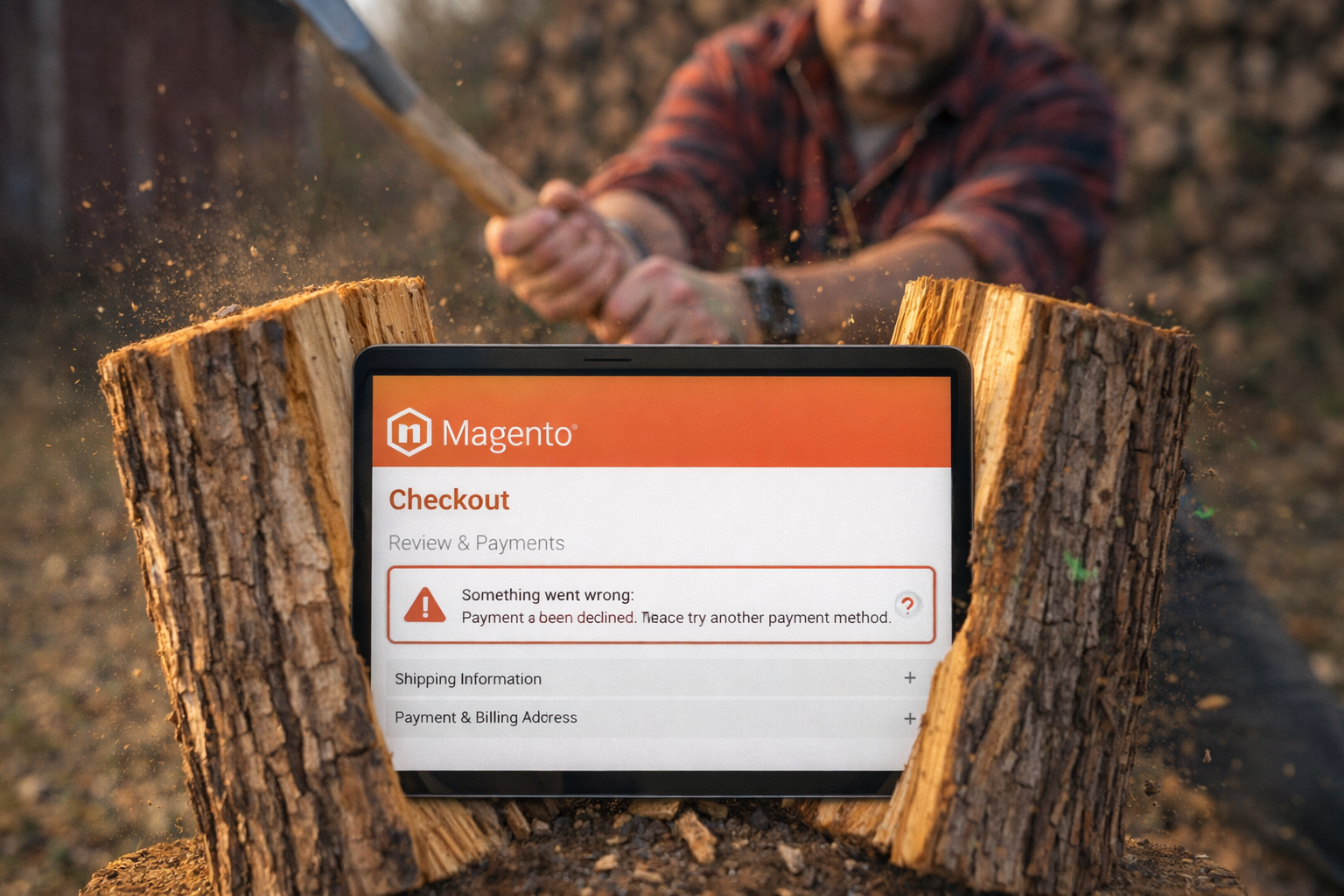
Checkout errors when inventory updates in real time
-
Orders that must be split across locations
-
Last-minute fulfillment failures
For pharmacy retailers, where purchases are often urgent, this friction becomes especially costly.
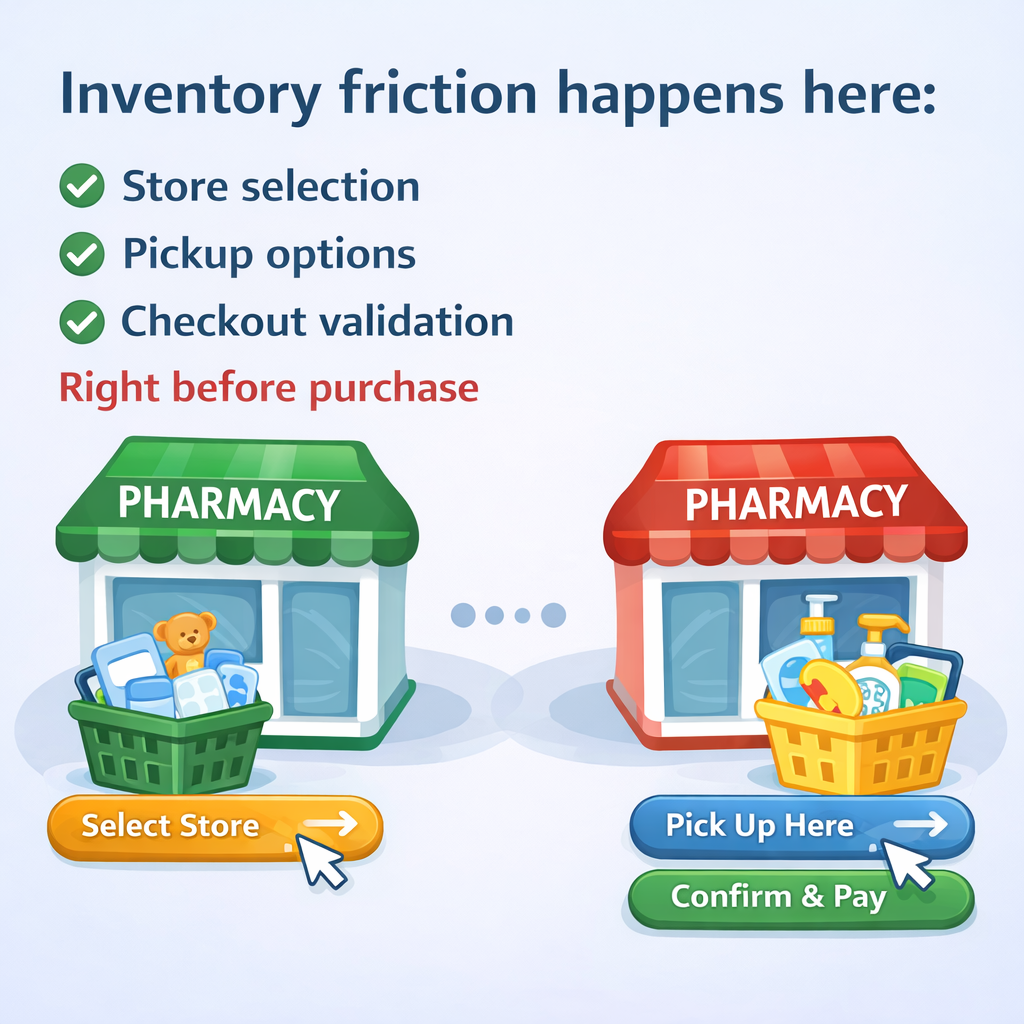
Real-World Example: Pharmacy Pickup and Store Inventory
Major pharmacy chains like Walgreens, CVS Health, and Boots heavily rely on store-based fulfillment for online orders.
This model allows customers to pick up products within hours and helps retailers avoid shipping costs.
But it also creates a complex inventory network:
-
Each store has different stock levels
-
Online orders compete with in-store shoppers
-
Store associates must locate items for pickup orders
According to retail studies, 36% of retailers say synchronizing online and in-store inventory is one of the biggest operational challenges in BOPIS programs.
Now imagine a real scenario.
A customer using the Walgreens website builds a basket of everyday essentials:
-
Pain relievers
-
Cold medicine
-
Vitamins
-
Tissues
-
Hand sanitizer
At checkout, the system flags that one product is only available at another location across town.
For the retailer, this is simply an inventory routing problem.
For the customer, it feels like the system failed at the last moment.
And at that point, switching to another pharmacy website or marketplace takes seconds.
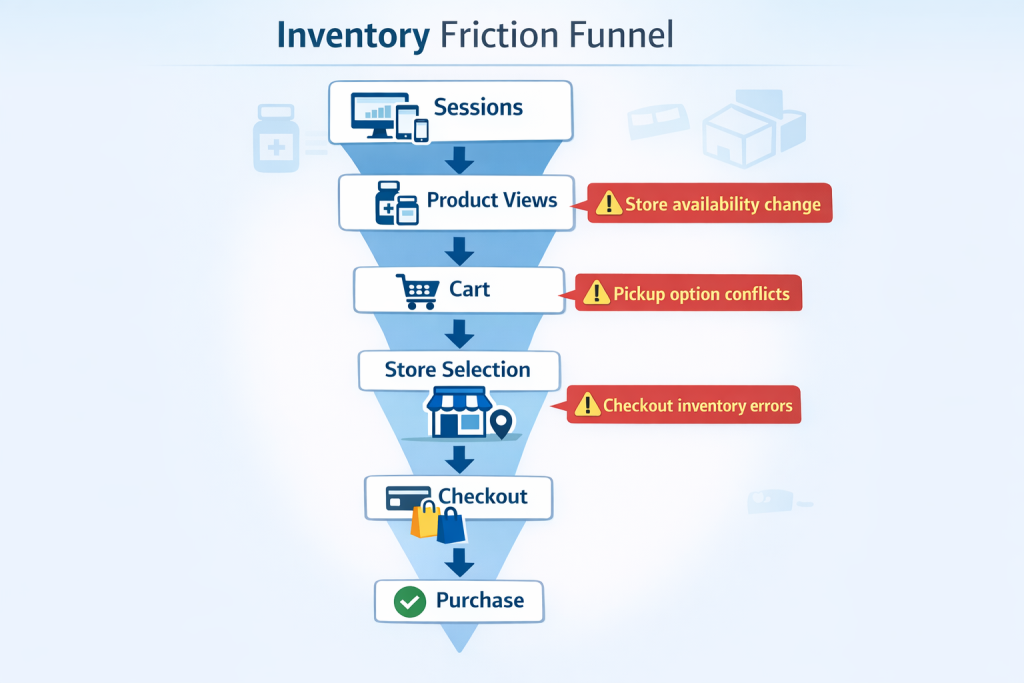
The Hidden Conversion Killer: Inventory Friction
Most ecommerce teams measure:
-
Conversion rate
-
Cart abandonment
-
Average order value
But those metrics rarely explain why a customer abandoned the purchase.
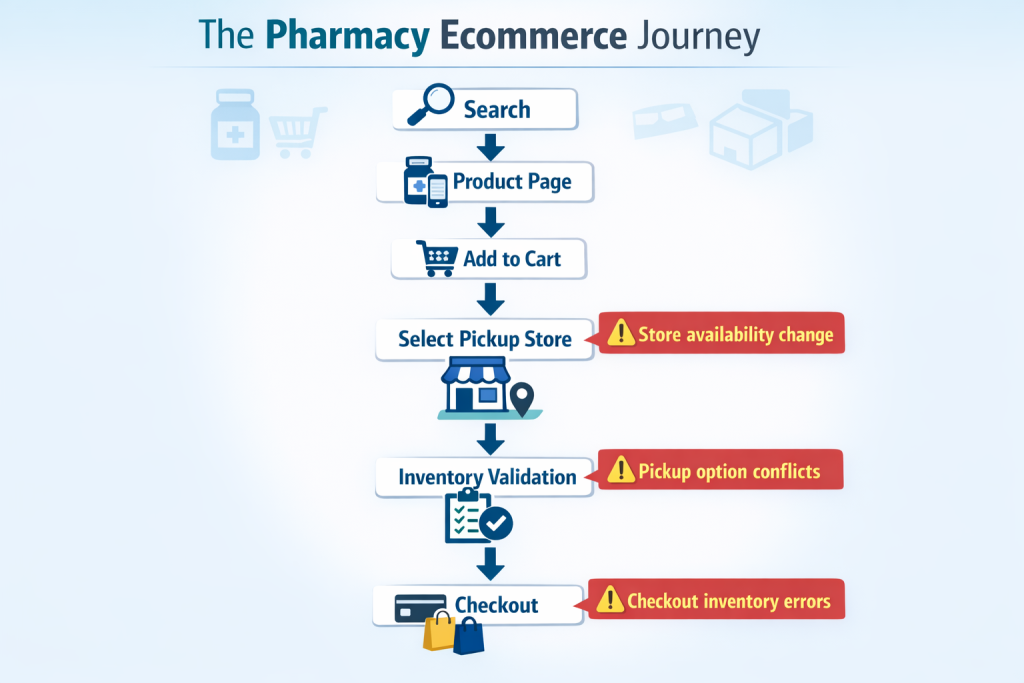
Inventory-related friction often hides inside the journey:
Common inventory friction moments
-
Store selection changes available items
-
Pickup availability disappears during checkout
-
Items suddenly become unavailable
-
Customers must split orders across stores
-
Delivery dates change unexpectedly
These events often occur after the customer already decided to buy.
Which makes them some of the most damaging conversion blockers in pharmacy ecommerce.
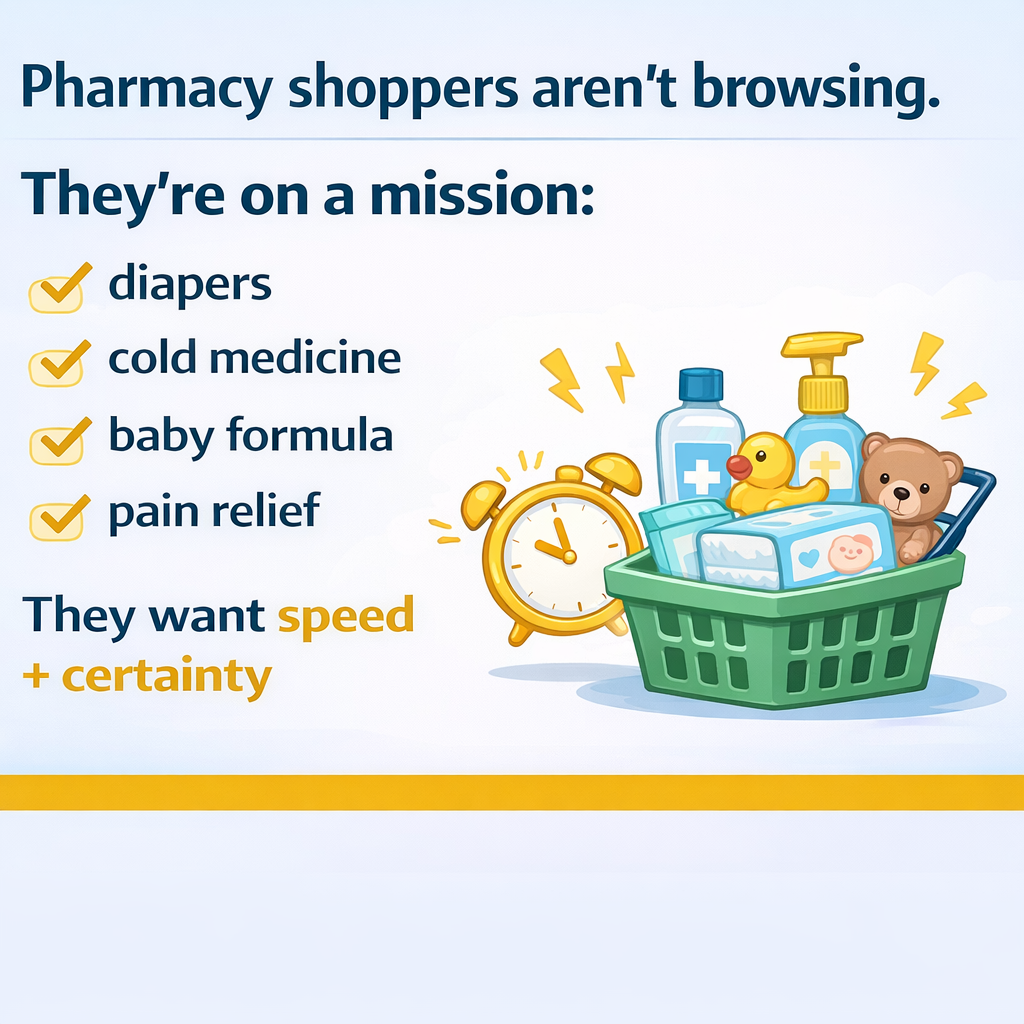
Why Pharmacy Shoppers Are Less Tolerant of Friction
In many ecommerce categories, shoppers are willing to browse or compare products.
Pharmacy shoppers are different.
They’re usually solving a specific need:
-
A sick child
-
A headache before bedtime
-
A last-minute baby supply run
When the checkout flow becomes complicated, customers quickly look for alternatives.
And those alternatives are everywhere:
-
Another pharmacy chain
-
Grocery delivery platforms
-
Marketplaces like Amazon
In other words, inventory friction directly drives revenue leakage.
Where Most Ecommerce Teams Lack Visibility
Many retailers are aware inventory issues exist.
But very few understand how often they break the customer journey.
Traditional analytics tools struggle to detect:
-
When users remove items because of store conflicts
-
Where inventory validation errors appear
-
Which products frequently trigger multi-location baskets
-
When customers abandon due to pickup limitations
These behaviors happen deep inside the interaction layer of the website.
Without behavioral visibility, they remain invisible.
What Leading Pharmacy Retailers Are Doing Differently
Forward-thinking pharmacy ecommerce teams are starting to treat inventory issues as both a supply chain problem and a customer experience problem.
Their approach typically includes three key strategies.
1. Detect inventory friction in real time
Understanding exactly where customers encounter problems in the journey:
-
store selection
-
availability validation
-
pickup options
-
checkout flows
This allows teams to quantify how often inventory breaks the purchase experience.
2. Offer smarter alternatives
When items are unavailable, retailers can automatically suggest:
-
Nearby store availability
-
Equivalent substitute products
-
Delivery options
-
Split-order optimization
This helps preserve the purchase instead of forcing the customer to start over.
3. Reduce last-step checkout failures
The worst possible moment for friction is the final step of checkout.
By identifying inventory mismatches early, retailers can prevent unexpected checkout disruptions.
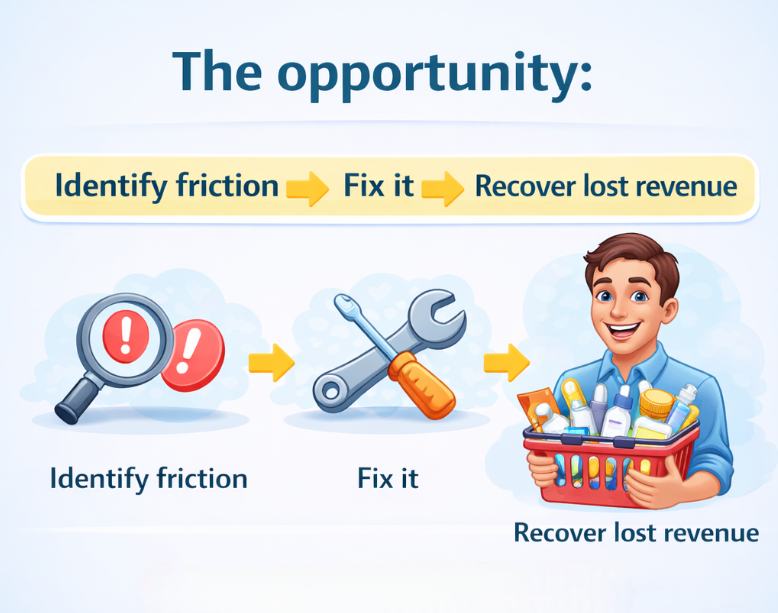
🧠 The New KPI Pharmacy Ecommerce Teams Should Track
As omnichannel complexity grows, pharmacy retailers should start monitoring a new metric:
Inventory Friction Rate
The percentage of sessions where the purchase journey is disrupted due to inventory conflicts across locations or fulfillment methods.
Tracking this metric helps answer questions like:
-
Which SKUs cause the most multi-store baskets?
-
How often do customers remove items due to availability?
-
Where in the journey does inventory break the experience?
These insights can unlock significant hidden conversion gains.
🔎 Why Inventory Friction Is So Hard to Detect
Most ecommerce analytics tools show that customers abandon the cart.
They rarely show why.
Inventory-related friction often happens inside micro-interactions like:
-
store selection widgets
-
pickup availability selectors
-
dynamic stock validation
-
checkout inventory checks
These events occur deep inside the user experience layer, making them difficult to detect using traditional analytics dashboards.
This is where behavior visibility becomes critical.
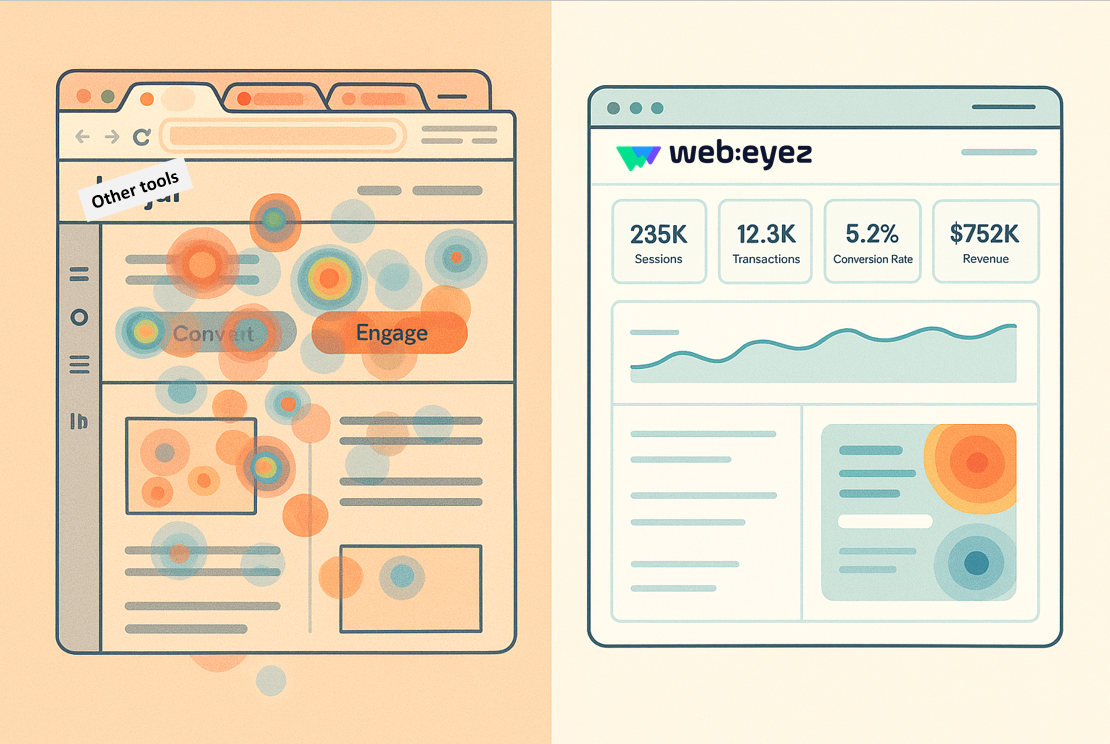
Platforms like Webeyez allow ecommerce teams to monitor real user behavior across the entire journey, automatically detecting friction points such as:
-
inventory-related checkout failures
-
unavailable items discovered late in the journey
-
store-selection conflicts
-
pickup option errors
Instead of discovering issues weeks later in analytics reports, teams can identify and fix inventory-driven UX failures as they happen.
For pharmacy retailers operating complex omnichannel networks, this visibility can uncover conversion opportunities hidden inside everyday customer journeys.
👉 The Bottom Line
In pharmacy ecommerce, conversion is rarely lost because customers changed their minds.
More often, it’s lost because inventory reality collides with customer expectations.
A single missing item.
A second pickup location.
A two-day transfer delay.
For shoppers with urgent needs, that’s often enough to abandon the purchase entirely.
And for pharmacy retailers, it’s a reminder that some of the biggest ecommerce optimization opportunities are hiding inside inventory-driven friction points.