

The Mother’s Day eCommerce Boom: Five-Year Trends and How to Win it
Mother’s Day has evolved into one of the biggest eCommerce events of the year, with shoppers around the world rushing to find the perfect gift for mom. In fact, it’s now ranked among the top retail holidays (trailing only the winter holidays and back-to-school season in some markets) and has seen surging online sales in recent years. This article dives into the past five years of Mother’s Day eCommerce data – from sales volumes by category to global shopping patterns and campaign performance metrics – and shows how merchants can capitalize on these trends. Most importantly, we’ll explore how Webeyez’s analytics platform enables eCommerce teams to optimize their sites around seasonal events like Mother’s Day, with session insights, funnel tracking, friction-point detection, and real-time monitoring that keep conversions on track.

Mother’s Day spending over the past decade
Mother’s Day by the Numbers: Five Years of Growth and Trends
Mother’s Day spending has soared over the past decade, reaching a record $35.7 billion in 2023 before a slight dip in 2024. The chart above illustrates this upward trajectory, with U.S. consumers steadily increasing their Mother’s Day expenditures year after year. In fact, total Mother’s Day sales grew every year from 2019 ($25.0 B) through 2023 ($35.7 B) – a span that included pandemic disruptions and economic uncertainty. Even 2020’s lockdowns didn’t halt growth, as more people turned to online gifting, pushing Mother’s Day spend to $26.7 B (up 7% from 2019). By 2024, total U.S. spend settled at $33.5 B – one of the highest figures on record – and forecasts for 2025 predict a rebound to around $34.1 B. Clearly, Mother’s Day has become an eCommerce force to be reckoned with, presenting huge revenue opportunities for online retailers.

Diamonds Are a Girl’s Best Friend
What are people buying for Mom? Gift preferences have shifted slightly in recent years, with both traditional tokens and higher-ticket items driving sales. Surveys consistently show that flowers and greeting cards remain the most popular gifts by volume (around 74% of shoppers buy these classics). However, spending data reveals that jewelry and electronics command the largest share of dollars in the U.S. market.
Jewelry and electronics lead Mother’s Day gift spending by category. In 2024, consumers shelled out roughly $7.0 billion on jewelry (the top category for the eighth year running) and $5.9 billion on electronics. Special outings (dinners, spa days, etc.) accounted for about $3.5 B, while gift cards and flowers each saw an estimated $3.2 B in sales. This shows that alongside bouquets and brunches, many shoppers are splurging on big-ticket items like tech gadgets and fine jewelry for mom. Fashion and beauty products are also major players: apparel is cited as a key growth category, and health/beauty items (from perfumes to skincare) rank among sought-after gifts, especially for younger consumers and in markets like the UK. In short, Mother’s Day spending spans a wide range of industries – from fashion and beauty to electronics and experience-based “gifting” – giving virtually every eCommerce sector a chance to shine.
Global Shopping Patterns Around Mother’s Day
Mother’s Day might be celebrated on different dates around the world, but its economic impact is undeniably global. North America tends to lead in total spend (the U.S. alone saw 84% of adults celebrating in 2023), yet other regions are catching up fast with their own traditions and eCommerce surges. Geographically, a few patterns stand out:
-
Timing and regional peaks: In the United States (and many countries), Mother’s Day falls on the second Sunday of May, whereas in the UK it occurs in March (Mothering Sunday) and in France it’s celebrated in late May or early June. These staggered dates create multiple “spikes” in global eCommerce activity. For example, UK retailers saw Mother’s Day spending hit £1.6–£2.4 billion in late March 2024-2025, while France experiences its boom in May/June. Smart international brands tailor their campaigns to each regional calendar.
-
Mobile and social commerce on the rise: Across the board, more Mother’s Day shopping is happening on smartphones and through social channels. In France, a remarkable 76% of Mother’s Day shoppers buy via mobile devices, with an average online order around €50. Social media and influencer recommendations are increasingly guiding gift purchases. Retailers worldwide are responding by optimizing mobile UX and leveraging social commerce – meeting customers where they scroll.
-
Local gift preferences: While flowers and chocolates are universally beloved Mother’s Day staples, there are interesting cultural differences in gift choices. In France, for instance, the top gifts are flowers (25% of intended purchases), perfume (8%), and chocolates (6%), followed by personalized gifts and books. Electronics and makeup are among the least popular Mother’s Day gifts in France, reflecting a cultural tilt toward classic and sentimental items. Meanwhile in the U.S., electronics have become a much more common gift ($4 B spent in 2023) as younger tech-savvy shoppers join the fray. In the UK, categories like clothing, fine jewelry, watches, and health & beauty are among the most sought-after gifts as of 2025. The takeaway for eCommerce managers is to know your audience in each market – localized merchandising and marketing can make all the difference in conversion rates.
-
Omnichannel shopping: Globally, consumers are blending online and offline touchpoints for Mother’s Day purchases. Even when the final sale happens in-store, the journey often starts with online research. In the U.S., 36% of Mother’s Day shoppers planned to buy online in 2025, slightly more than those going to department stores (32%) or specialty shops (29%). And Amazon has become a go-to in many countries (over 60% of Mother’s Day shoppers in one survey plan to use Amazon). For eCommerce teams, this means digital presence is critical not just for online sales, but for driving store traffic and inspiration as well.
Campaign Performance Metrics: How Shoppers Behave Around Mother’s Day
Seasonal events like Mother’s Day come with unique consumer behavior patterns. Understanding these can help marketers fine-tune their campaigns and website experience. Over the past five years, data shows Mother’s Day shoppers to be early researchers, last-minute buyers, and deal-driven – a combination that makes close monitoring of conversion metrics essential. Let’s break down some key trends in customer behavior and campaign performance:
-
Early birds start browsing (and comparing) weeks in advance: Unlike the winter holidays, Mother’s Day doesn’t always see a huge month-long shopping frenzy – but savvy consumers do start researching gifts early. In 2024, transactions in the month leading up to Mother’s Day were 4% higher than the previous year, and clicks surged by 38% as shoppers scouted products and prices. However, many of these early visitors were in “browse mode,” which contributed to a 24% lower conversion rate in the weeks before the big day. Essentially, people spent more time window-shopping and weighing options in advance, waiting for the best deals before pulling the trigger. For marketers, this highlights the importance of engaging customers early (with gift guides, wish lists, email reminders, etc.) even if the final purchase comes later.
-
Conversion rates spike as the day draws near: As procrastinators and deal-seekers finally make up their minds, conversion rates tend to peak in the last 48 hours before Mother’s Day. In 2024, the highest conversion rate was recorded on the day before Mother’s Day, when urgency is at its maximum. Many shoppers also continue buying on Mother’s Day itself – perhaps for e-gift cards or “belated” gifts – but interestingly, 2024 saw a 2% dip in transactions on the actual day (possibly because more people had already completed purchases earlier). Nonetheless, retailers observed that clicks on Mother’s Day were up 29% as people were still actively browsing offers. The lesson: a strong last-minute push (with express shipping options, digital gift cards, and prominent “still in time!” messaging) can capture those final conversions. It’s also when your site needs to perform flawlessly under traffic spikes.
-
Higher intent can lead to higher conversion – if your site delivers: By the final week of the campaign, shoppers who have done their research often convert at well above-average rates. One online flower retailer, UrbanStems, reported that some of its targeted landing pages achieved 8–11% conversion rates in the week of Mother’s Day – far exceeding typical eCommerce benchmarks. They optimized by A/B testing elements like customer reviews (removing reviews caused a 25% drop in conversions in testing, proving how crucial social proof is for gift purchases) and simplifying checkout flow for speed. This underscores how site experience directly impacts sales: even with high intent visitors, friction or uncertainty can cost you. Conversely, removing friction can boost conversions dramatically, as UrbanStems saw with a 200% lift in conversion by using a faster, optimized landing page for their paid social traffic. Cart abandonment tends to fluctuate during this period as well – many shoppers add items to cart early on, then return later to complete the purchase once they’ve price-checked or waited for a promo. Ensuring saved carts, retargeting abandoned carts with reminders, and offering incentives like free shipping can help recover these sales.
-
Average order values and item counts are shifting: Interestingly, Mother’s Day shoppers have been spending more per item but buying slightly fewer items per order in recent years. In 2024, the average order value actually dropped ~3%, but that was because consumers purchased ~9% fewer items on average – they were paying ~6% more per item compared to the previous year. This suggests a trend toward quality over quantity (e.g. one nice gift instead of multiple smaller ones), likely influenced by inflation and a desire to make the gift count. It may also reflect shoppers splitting their purchases across multiple retailers to find exactly what mom wants. For eCommerce managers, tracking AOV and basket composition around Mother’s Day is key – are customers buying add-ons and complementary products, or just that one special item? Armed with that knowledge, you can adjust your upselling, bundles, or free gift promotions accordingly.
In summary, Mother’s Day amplifies both opportunities and challenges in the customer journey. Traffic and engagement climb early, then conversion rate surges late. Customers are often more decisive yet demanding – they know what they want (and that time is short), so any friction can turn them away quickly to a competitor. This is why having real-time insight into your funnel performance during such peak periods is critical. You need to spot where shoppers drop off, why carts might be abandoned, and how site issues might be impacting sales as it happens. This is precisely where Webeyez comes in.
Optimizing the Mother’s Day Rush with Webeyez
For eCommerce teams, seasonal peaks like Mother’s Day are “all hands on deck” moments. The spike in traffic and transactions is fantastic for business – but it also means that any UX hiccup, slow page, or broken element on your site can impact thousands of shoppers and potentially cost millions in lost revenue. To truly capitalize on the Mother’s Day boom, you need to ensure a flawless, conversion-friendly shopping experience from start to finish. Webeyez’s platform is designed to give eCommerce managers that superpower of insight and agility, especially during high-stakes events. Here’s how Webeyez can help you optimize performance around Mother’s Day (and any seasonal campaign):
-
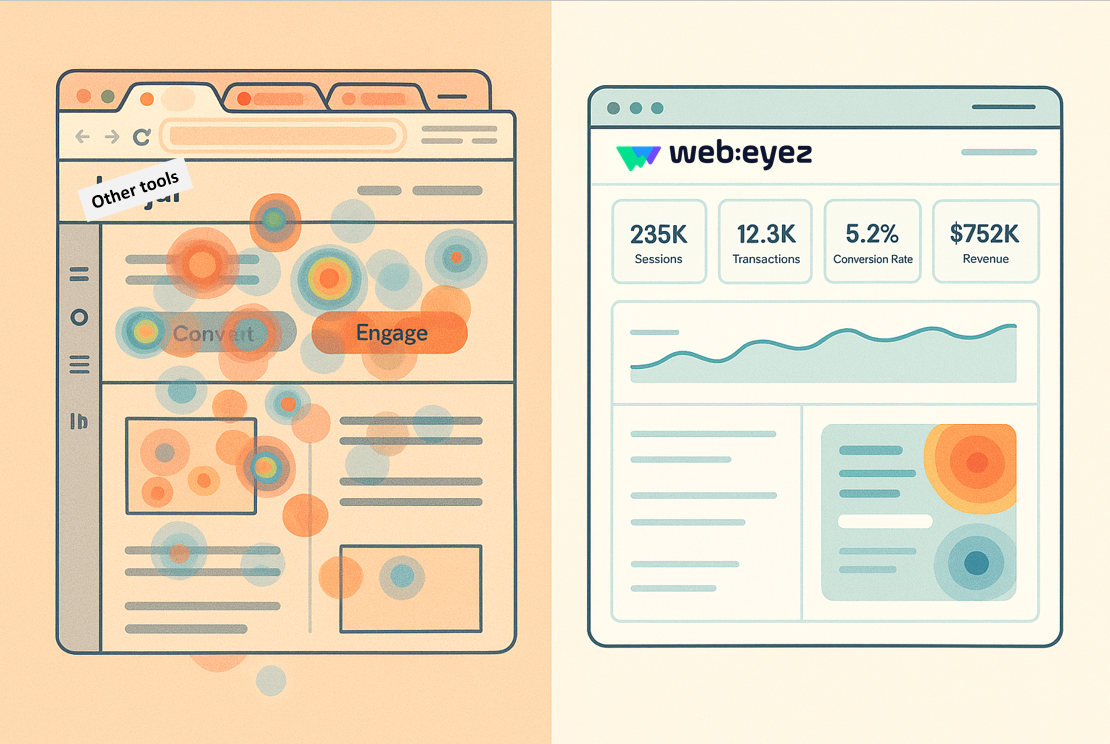
Holistic Funnel Tracking & Conversion Analytics: Webeyez continuously analyzes your online funnel in real time, pinpointing the exact areas where shoppers encounter issues. From the moment a visitor lands on your site to the moment they complete checkout (or drop off), you have full visibility into each step of the journey. This means you can see exactly where conversion rates dip or where carts are being abandoned. For example, if during the Mother’s Day rush you notice an unusual drop-off at the shipping-options step, Webeyez will highlight that friction point so you can investigate immediately (perhaps the expedited shipping fee is too high, or a glitch is preventing selection). By monitoring funnel KPIs live, you can react during the campaign – not after the fact – to optimize conversion flow.
-
Session Insights via Real-Time Session Recordings: Numbers alone only tell part of the story. Webeyez lets you see your website through your customers’ eyes with real-time session replay and screen recordings. This is a game-changer when traffic is peaking. You can watch actual user sessions to understand exactly how shoppers are interacting with your pages: Where do they hesitate? How are they navigating product pages or filtering gifts? Did they encounter an error message or dead link? By visually uncovering these behaviors and pain points, you can quickly diagnose UX issues. For instance, if recordings show multiple users struggling to apply a Mother’s Day promo code, you can rectify the issue (or post a quick how-to) immediately. These session insights help you uncover hidden friction points that traditional analytics might miss, so you can fix them on the fly and keep customers moving toward purchase.
-
Friction Point Identification (Powered by AI): One of Webeyez’s core strengths is real-time friction detection. The platform uses intelligent algorithms to flag anything abnormal – from technical errors to slow load times to unusual drop-offs – and it prioritizes the critical friction points that need your attention. Think of it as an early warning system. During a seasonal campaign, this is invaluable: if an influx of mobile traffic is causing a particular script to crash for Safari users, or if the payment gateway starts timing out under load, Webeyez will alert you immediately. By surfacing these issues along with context (e.g., “Checkout step – 5% error rate in last 10 minutes”), Webeyez enables your team to jump in and resolve problems before they snowball into lost sales. Many retailers only discover such issues after seeing a revenue drop or getting customer complaints – with Webeyez, you discover and fix them in real time. The result is a smoother, more reliable shopping experience for your customers, even at peak load.
-
Real-Time Monitoring & Alerts: During a high-pressure event like the run-up to Mother’s Day, you don’t have time for manual checking of every metric. Webeyez has your back with real-time analytics dashboards and alerts. You can set thresholds to be notified if, say, conversion rate falls below X% or cart abandonment spikes above Y%. The platform’s actionable recommendations then guide you on what to investigate. For example, an alert might highlight that “Mobile checkout conversions are down 15% in the last hour” – prompting you to review session replays or funnel steps specifically for mobile users. By staying ahead of potential issues and performance dips, you maintain control in the chaotic last days of the campaign. Webeyez essentially acts as your mission control, so you’re never flying blind when it matters most.
-
Data-Driven Decision Making for Campaign Optimization: Beyond troubleshooting, Webeyez equips you with rich data to make informed marketing decisions on the fly. You can track which landing pages or referral sources are yielding the best conversion, see how a new gift guide or homepage banner is influencing behavior, and even identify opportunities like high-engagement products that could be promoted more. All of this is available in real time, so during the Mother’s Day push you could, for instance, spot that a particular category (e.g. “spa gift cards”) is trending in searches or has a high view-to-cart rate – insight that might inspire an immediate tweak to feature those items more prominently. Webeyez’s goal is to turn data into action, empowering you to continuously optimize the experience and maximize revenue throughout the campaign.
In short, Webeyez helps eCommerce managers be proactive, not reactive. By visualizing customer behavior and highlighting pain points as they occur, you’re able to deliver a frictionless journey even under peak demand. Every session that goes smoothly is a potential sale saved; every frustration caught early is a customer kept happy. And the benefits extend beyond Mother’s Day: the insights and improvements you gain carry forward to all seasonal events (think Father’s Day, Black Friday, holiday season), creating a cycle of continuous optimization.
Conclusion: Prepare, Optimize, and Thrive on Big Seasonal Days
Mother’s Day has grown into a massive eCommerce opportunity over the past five years, and all signs point to this trend continuing. The companies that succeed during seasonal surges are those that prepare with data-driven strategies and stay agile in execution. By understanding category trends (e.g. what moms want in 2025), catering to regional shopping habits, and closely watching campaign metrics like conversion rates and AOV, you can craft marketing campaigns that hit the mark. And with a platform like Webeyez in your toolkit, you gain the confidence that when traffic spikes, your website will perform at its best – because you’ll see issues before your customers do, and you’ll optimize the experience in real time.
For eCommerce managers and marketers, this means less guesswork and scrambling, and more celebrating those record-breaking sales days. Webeyez provides the session-level insights, funnel visibility, and real-time monitoring needed to turn a seasonal spike into sustained success. So as the next Mother’s Day (and the next big holiday) approaches, ask yourself: Is my eCommerce experience ready for prime time? With the right data and the right tools, you can ensure the answer is a resounding yes – and make every shopper’s journey as delightful as the gift they’re about to give.
Happy selling, and Happy Mother’s Day!
Sources:
- National Retail Federation – Annual Mother’s Day Spending Surveys, 2021–2025, mytotalretail.com, nrf.com
- Impact.com – Mother’s Day 2024 Consumer Trends Report
- Oberlo / NRF – Mother’s Day Spending Statistics (2013–2024), oberlo.com
- TheIndustry.beauty / GlobalData – UK Mother’s Day Market Report 2025, theindustry.beauty
- MikMak – Mother’s Day Shopping Trends in France (2023), mikmak.com
- DigitalCommerce360 – Mother’s Day Campaign Performance (UrbanStems case study), digitalcommerce360.com
- Webeyez – Platform – Data
- wix.com